Watches&Wonders 2015 – Panerai Luminor 1950 3 Days Titanio DLC 47mm PAM 629: Case in Point

Panerai Luminor 1950 3 Days Titanio DLC 47mm in titanium with DLC (Diamond-Like Carbon) coating and the famously unmistakable California dial. This is the first time a California dial is on a Luminor case. The California dial was used on the first Panerai prototype watch in 1936. Launched at Watches&Wonders at end-September 2015, this watch has our vote because of the many firsts associated with the California dial in Panerai’s history. Priced at EUR11,400 / HK$91,000. Photo: © TANG Portfolio. Elfa / Timmy. Watches&Wonders 2015, Hong Kong

Panerai Luminor 1950 3 Days Titanio DLC 47mm in titanium with DLC (Diamond-Like Carbon) coating and the famously unmistakable California dial. This is the first time a California dial is on a Luminor case. The California dial was used on the first Panerai prototype watch in 1936. Launched at Watches&Wonders at end-September 2015, this watch has our vote because of the many firsts associated with the California dial in Panerai’s history. Limited to 300 pieces. Priced at EUR11,400 / HK$91,000. Photo: © TANG Portfolio. Elfa / Timmy. Watches&Wonders 2015, Hong Kong

Panerai’s Luminor 1950 3 Days Titanio DLC 47mm or PAM 629, launched at the recently concluded Watches&Wonders 2015 exhibition (30 September to 3 October 2015) and held at the Hong Kong Convention and Exhibition Centre, marks yet another first for the “California” dial made famous by this brand.

What is the California dial? The California dial is characterized by half-Arabic, half-Roman numerals for its hour indexes.

The top half of the dial features the Roman numerals I, II, X and XI, while the lower half has the Arabic numerals 4, 5, 7 and 8. The indexes for 3, 6 and 9 are represented by bar indexes while a triangular symbol is at 12 o’clock.

The California dial style is said to have been first used by Rolex for its Bubble Backs in the 1930s.

In 1936, Panerai supplied its first prototype watch to the Royal Italian Navy and it is generally accepted that it was a Radiomir watch ref. 3646 equipped with a Rolex movement, the California dial and wire loop handles that held the leather straps for securing the watch to the wrist.

In other words, the California dial marked a first as it was used for Panerai’s earliest-known diver’s watch supplied to the Royal Italian Navy. One must also not forget that this Radiomir ref. 3646 of 1936 with the California dial was the first watch in Panerai’s history.

It was only in 2006 that Panerai created a version that was based on their first diver’s watch with the California dial and it was named the Radiomir 1936 or PAM 249 which became highly sought-after.

Since then, there have been a few more Panerai watches featuring the California dial but these have all been housed in Radiomir cases. One example will be the PAM 424 in steel featuring the California dial with a date display launched in 2012.

Panerai’s Luminor 1950 3 Days Titanio DLC 47mm or PAM00629 is one of two special editions that was launched at Watches&Wonders 2015.
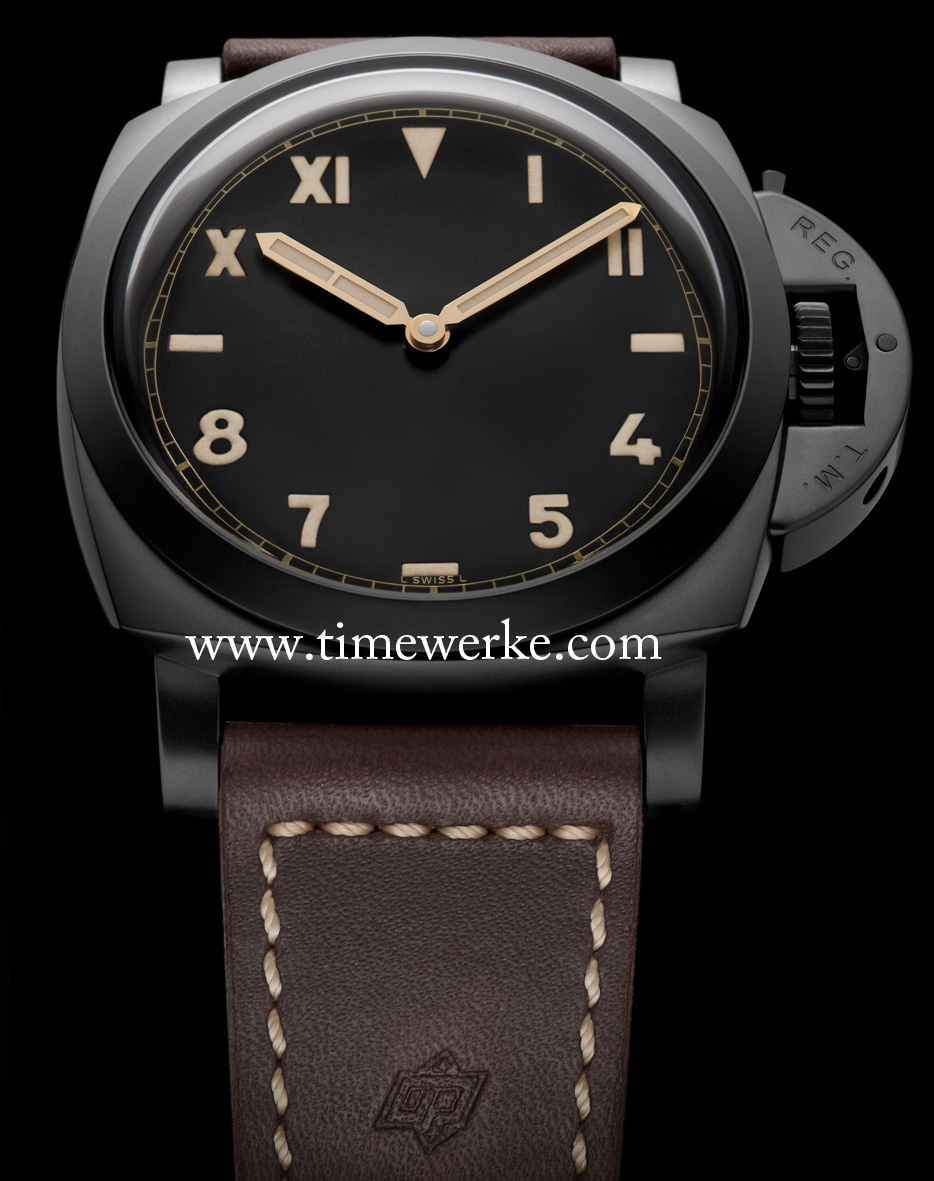
The PAM 629 or Panerai Luminor 1950 3 days Titanio DLC 47mm is powered by the brand’s in-house Calibre P.3000 manual-winding movement with 72 hours or three days of power reserve. Photo: © Panerai

The PAM 629 or Panerai Luminor 1950 3 days Titanio DLC 47mm is powered by the brand’s in-house Calibre P.3000 manual-winding movement with 72 hours or three days of power reserve. Photo: © Panerai

What makes the PAM 629 truly special? “This is the first time the California dial is used on a Luminor case,” says Alessandro Ficarelli, product development director, Panerai, who by the way, celebrates his 10th anniversary with the brand in 2015. He joined the brand in 2005 – the year Panerai launched its first in-house movement, the P.2002.

The Luminor case refers to modern-day Panerai watchcases (from 1993 onwards) with the characteristic lever-operated crown-locking mechanism.

The case with this lever device that protected the crown, which is now an iconic design feature for Panerai, was designed in 1950, according to the brand. This crown protector is meant to improve the water-resistance of the case

As explained in the book Panerai in Florence: 150 years of history, this was a patented mechanism that “… made it possible to considerably increase the seal of Panerai’s diver’s watches in that, when the lever was lowered, the winding crown was pushed axially against the watchcase, causing the compression of its own seal”.

Fans and collectors of Panerai should note that there are two types of modern-day Luminor cases: the “Luminor 1950” case for instance, has been designed with proportions faithful in every detail to the watches of that era.

The first modern-day Panerai Luminor 1950 with a reproduction of this historic case was launched in 2002 and it was for the PAM 127 special edition watch.

Panerai watches with the “Luminor 1950” designations are therefore those with cases designed to be like the original of 1950.

The PAM 127 with the Luminor 1950 case is also known as the “Fiddy” for the “1950” inscribed on the dial. However, this is not the case (pun intended) for the PAM 629 as historically, it has a dial with no branding nor text to positively identify the manufacturer as it was supposed to be used by the Italian commandos for their military missions.

There is still a “1950” year marking on the PAM 127 though. It can actually be found engraved on the lever locking the winding crown.

Panerai watches housed in Luminor cases without the “1950” designation and featuring the lever device have designs that are slightly revised. Production of such modified cases with the crown protection mechanism first began in 1993.

As highlighted by the brand: “It can therefore be said that the Luminor case was inspired by the modern history of Panerai while the Luminor 1950 case was linked to the past history of the brand: the legendary story of the commandos and their missions”.

The PAM 629 or Luminor 1950 3 Days Titanio DLC is housed in a case made of titanium, as its name also implies while not forgetting that its case is similar to the original of 1950.

What is different from the original of 1950 though, is not just the material but the colour – this 47mm case in titanium has a black DLC (Diamond-Like Carbon) coating. It is powered by the P.3000 manual-winding in-house movement.

As the first California dial in a Luminor 1950 case, there is no doubting why the PAM 629 has been classified as a special edition.

We do believe that the PAM 629 makes a strong case (pun intended) for those considering a Panerai watch, whether as their first or yet another for their collection.

Rotonde de Cartier Grande Complication Skeleton watch: Time to Strike

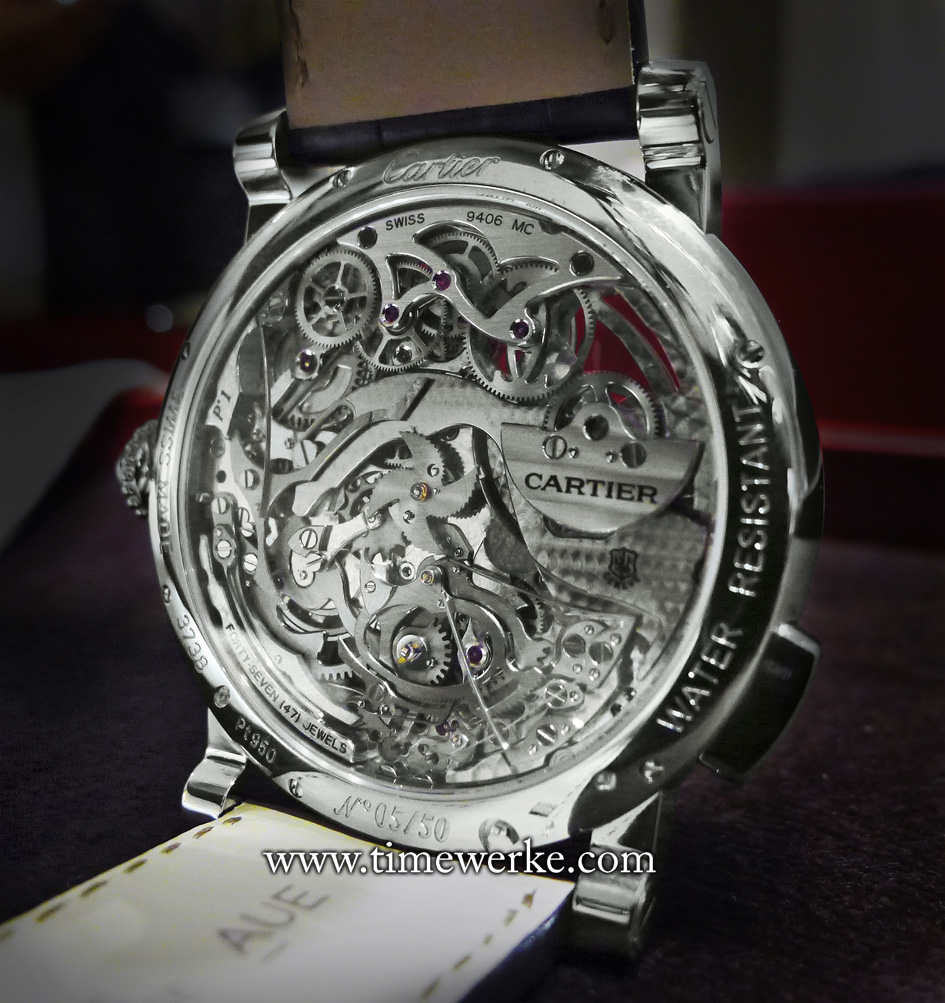
Rotonde de Cartier Grande Complication Skeleton watch. Introduced in 2015, it houses the Calibre 9406 automatic movement that comprises 578 components. The Calibre 9406 self-winding movement required 5 years of development time, 15 weeks of production time at the Cartier Manufacture, 10 weeks of decoration and finishing work and 5 weeks of assembly time. The skeleton movement is certified Poinçon de Genève and has approximately 50 hours power reserve after being fully wound. The Rotonde de Cartier Grande Complication skeleton watch features the minute repeater, flying tourbillon and perpetual calendar. Its 45mm diameter case is in 950 platinum and is 12.6mm thick. Priced at US$620,000. Photo: © TANG Portfolio. Elfa / Timmy. 2015 Salon International de la Haute Horlogerie

Rotonde de Cartier Grande Complication Skeleton watch. Introduced in 2015, it houses the Calibre 9406 automatic movement that comprises 578 components. The Calibre 9406 self-winding movement required 5 years of development time, 15 weeks of production time at the Cartier Manufacture, 10 weeks of decoration and finishing work and 5 weeks of assembly time. The skeleton movement is certified Poinçon de Genève and has approximately 50 hours power reserve after being fully wound. The Rotonde de Cartier Grande Complication skeleton watch features the minute repeater, flying tourbillon and perpetual calendar. Its 45mm diameter case is in 950 platinum and is 12.6mm thick. Priced at US$620,000. Photo: © TANG Portfolio. Elfa / Timmy. 2015 Salon International de la Haute Horlogerie

What happens when watchmaking complications such as the minute repeater, flying tourbillon and perpetual calendar are put together in a Cartier timepiece?

You will get the most complex of all Cartier timepieces and this is exactly what the brand debuted at the 2015 Salon International de la Haute Horlogerie in Geneva.

Known as the Rotonde de Cartier Grande Complication Skeleton watch, the brand required five years of development time, took fifteen weeks of production at its Manufacture, 10 weeks to decorate and finish, not to mention five weeks for the assembly.

The movement, the Manufacture Calibre 9406 MC, was assembled and set at Cartier’s fine watchmaking workshops in Geneva, above the brand’s boutique at 35 rue du Rhône.

“It took five years of development time from the brief to homologation,” highlights Carole-Forestier Kasapi, head, Movement Creation Department, Cartier. Kasapi is essentially the brainchild behind most, if not all, of the modern and amazing horological creations of the brand.

“The biggest challenge,” she adds, “… is the addition of complications and what was truly complicated were the issues and solutions regarding the thickness of the movement.”

Do note that the movement of the Rotonde de Cartier Grande Complication Skeleton watch, the Calibre 9406 MC, comprises 578 components. Indeed, what is most amazing is that this Calibre 9406 MC extra-flat skeleton automatic movement which packs in the high complications has the total diameter of 35mm and is merely 5.49mm thick!

Little wonder why the Rotonde de Cartier Grande Complication Skeleton watch is what the brand touts as its “most complex of all Cartier watches”.

“The thickness of 5.49mm marks a record for us. However, it was not our objective to seek out records when creating this movement,” she stresses.

The best way to understand and appreciate Cartier’s high horology complication piece is firstly, to slowly admire what is displayed on its dial.

At the 12 o’clock position is the flying tourbillon that features a titanium carriage that makes it more lightweight. A flying tourbillon is essentially a tourbillon but it does not feature an upper bridge that secures the [tourbillon] mechanism. Hence the “flying” tourbillon.

There a a platinum micro-rotor on the Calibre 9406 MC. It can be seen through the transparent sapphire case back on the Rotonde de Cartier Grande Complication Skeleton watch. This is an innovative two-level micro-rotor that enables a reduction in winding speed while limiting energy loss, the brand highlights.

The platinum micro-rotor at just about the three o’clock position. This is a two-level micro-rotor construction. Photo: © TANG Portfolio. Elfa / Timmy. 2015 Salon International de la Haute Horlogerie

The platinum micro-rotor at just about the three o’clock position. This is a two-level micro-rotor construction. Photo: © TANG Portfolio. Elfa / Timmy. 2015 Salon International de la Haute Horlogerie

On the Rotonde de Cartier Grande Complication Skeleton watch, the perpetual calendar displays are: the day of the week at 3 o’clock, the date at 9 o’clock and the month at 6 o’clock.

The leap year indication is also at the 6 o’clock position. A leap year occurs every four years. If kept continuously running, the calendar displays on the Rotonde de Cartier Grande Complication Skeleton watch will only require adjustments once every 100 years.

From the dial side of the Rotonde de Cartier Grande Complication Skeleton watch, one can also view the striking action of its minute repeater complication as the two hammers and gongs are visible.

Even the inertial fly-wheel is visible and it is located above the left hammer, between the seven and eight o’clock positions. The inertial fly-wheel regulates the rhythm and duration of the striking operation. The “inertial fly-wheel is freed of its upper bridge, making it truly ‘fly’,” states the brand.

“Developing the minute repeater mechanism was a very scientific process for us. There was a lot of software involved and it allowed us to understand what we were doing.

“Each time you move something, you change the sound because there are vibrations and with such software, we could see the level of intensity, richness, harmonics and timing frequency between each strike.

“The inertial wheel is for regulating the speed of the minute repeater action and one advantage is that it reduces any external noise that can affect the quality and sound of the strikes,” explains Kasapi.

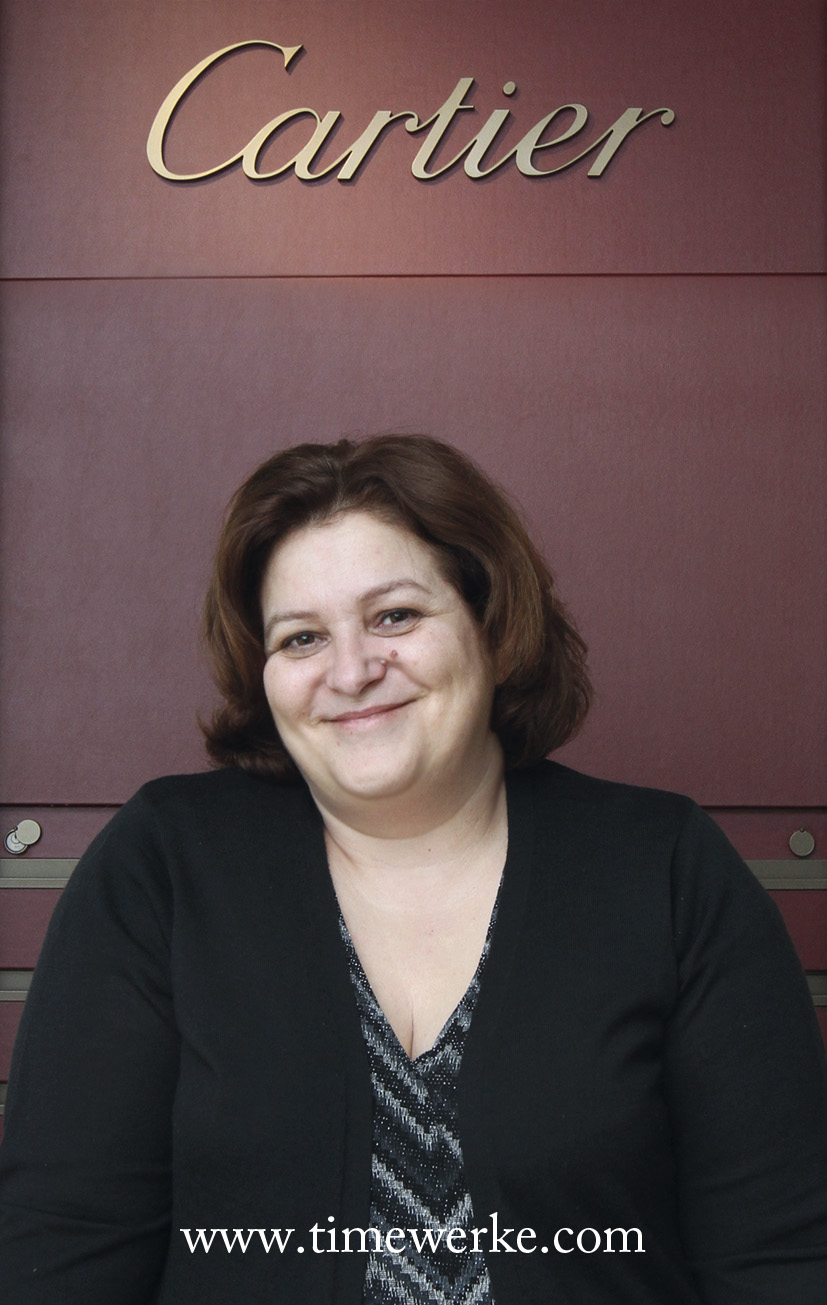
Carole-Forestier Kasapi, head, Movement Creation Department, Cartier. A watchmaking genius, she is the brainchild behind most, if not all, of the modern and amazing horological creations of the brand. Photo: © TANG Portfolio. Elfa / Timmy. 2015 Salon International de la Haute Horlogerie

Carole-Forestier Kasapi, Head, Movement Creation Department, Cartier. A watchmaking genius, she is the brainchild behind most, if not all, of the modern and amazing horological creations of the brand. Photo: © TANG Portfolio. Elfa / Timmy. 2015 Salon International de la Haute Horlogerie

The minute repeater is a key highlight and challenge for the watch Manufacturers these days, more so than the tourbillon. “The tourbillon is today as common as the chronograph was 50 years ago. As such, this has led to the ‘demonisation’ of the tourbillon. That is why the focus in now on minute repeaters,” surmises Kasapi.

One security feature is the Rotonde de Cartier Grande Complication Skeleton watch is the all-or-nothing mechanism. Such a feature will mean the striking mechanism will either function correctly or not at all.

This is due to the fact that an inaccurate sounding of the time might result if for example, the repeater slide or pusher has not been activated properly. As such, the all-or-nothing mechanism is for avoiding partial activation of the striking system to prevent an inaccurate acoustic indication of time.

The million-dollar question is whether Cartier and Kasapi’s team have achieved the right balance in terms of sound acoustics for the Rotonde de Cartier Grande Complication Skeleton watch.

The brand has indicated that their study of “acoustics harmonics and tonalities has allowed them to combine the nobility of a platinum case with the richness of a unique sound that is at once clear and precise, pure and soft”.

Did the Rotonde de Cartier Grande Complication Skeleton watch exude clear, precise, pure and soft acoustics? The proof of the pudding is in the eating.

With the Rotonde de Cartier Grande Complication Skeleton watch on hand, Kasapi gladly obliged in sounding its striking mechanism.

How was the minute repeating acoustics? It was slow and steady, with a regular tempo. Yes, it was clear, precise and pure as well. It was actually impressive that this level of acoustics could be achieved with a platinum case.

We made an audio recording of the Rotonde de Cartier Grande Complication’s chiming thanks to Kasapi in January 2015 at the Salon International de la Haute Horlogerie. To have a better listening experience, do remember to turn up the volume and simply click on the play button below. Do pardon us for the background noise as the recording was not made in a sound room. The striking mechanism was activated by Carole-Forestier Kasapi. In other words, Cartier’s resident watchmaking genius is playing this for you:


Do you what time was struck? The chiming indicated that it was 12.54.

The movement, the Calibre 9406 MC, is skeletonized and it bears the Poinçon de Genève – the Geneva Seal. This means that the movement finishing, which includes chamfering of the bridges, drawing of the flanks and the polishing of the countersinks, are of high standards.

Cartier has definitely gained new ground in high horology with its Rotonde de Cartier Grande Complication. This is an amazingly elegant and highly complicated wristwatch. Photo: © TANG Portfolio. Elfa / Timmy. 2015 Salon International de la Haute Horlogerie

Cartier has definitely gained new ground in high horology with its Rotonde de Cartier Grande Complication. This is an amazingly elegant and highly complicated wristwatch. Photo: © TANG Portfolio. Elfa / Timmy. 2015 Salon International de la Haute Horlogerie

What’s more, the Rotonde de Cartier Grande Complication Skeleton watch features an openwork dial in 18K white gold. This allows the open display of its three high complications – the flying tourbillon, the perpetual calendar and what is most striking, literally (pun intended), is the striking mechanism of its minute repeater.

As the most complex of all Cartier watches to date, the Rotonde de Cartier Grande Complication Skeleton has undoubtedly achieved new heights for the brand in the high horology segment.

Another related article on minute repeaters on timewerke.com which we highly recommend is:
i. The world’s first wristwatch minute repeater: Still sound